
Wednesday, 8 September 2010
Sentinal Boats


Tuesday, 7 September 2010
Summer is not far off?

Friday, 3 September 2010
The start of spring in Cape Town
This is a picture lifted from the Cape Town Tourist web site,there is no name mention but it was taken today,friday 3rd of September,what a stunning picture and what a great place to visit, its vistas like this we see so often that underline why I have lived here so long.
 Roy
Roy

Wednesday, 1 September 2010
The Dix 470 cruising catamaran

Wild Vanilla,the DH55 that Phil Harvey built for his own use with his family,certainally one of the better looking large catamarans I have seen.


Dix 470
Wood/epoxy cruising catamaran
Cruise in luxury
~ Large cruising catamaran
~ Radius chine plywood/epoxy construction
~ All the space for family comforts
~ Great boat for charter or long distance cruising
~ Shallow draft
~ Smaller sister to DH550
MENU
The Dix 470 cruising catamaran is a smaller sister to the DH550, which has shown itself to be a beautiful boat. Many people have asked for a smaller sister, so here she is.
Construction is a development of the radius chine plywood concepts that Dudley has drawn since the early 1990’s. These concepts started with the monohull Didi 38 “Black Cat”, which he built to test the construction method then sailed across the South Atlantic three times. Since then he has developed other performance oriented monohull designs of similar concept, from 21 to 42ft LOA. Hundreds of boats to this method are in build or sailing worldwide.
As successful as the radius chine plywood monohull designs have been, the DH550 project showed that this construction method is even better for catamaran hulls than it is for monohulls. The hulls of Phil Harvey's DH550 were quick to build and are fair and pretty to look at.
This is a big and powerful boat and it is intended for cruising the oceans of the world. To take on that role, it has 1m (39”) bridgedeck clearance to minimize slamming in big seas. The hull/bridgedeck junction has received particular attention to ensure that the loads imposed by rig and ocean are properly transmitted and shared between them. Carbon composite chainplates are laminated to the inside and outside of the hull and spread the rigging loads down into the hull skin, longitudinals and bulkheads. The mast stands on top of a major transverse bulkhead that is configured as an I-beam to spread the compression load laterally into the hulls and is tied into longitudinal bulkheads that spread the load fore/aft into the bridgedeck structure.
The interior arrangement is modeled around 2 cabins in each hull, sharing a common heads/shower area that separates them for privacy. That makes this boat suitable for 4-couple bare-boat charter work.
Bridgedeck accommodation is spacious, with separate galley, steering, navigation, dining and relaxation areas. Forward of the bridgedeck accommodation is a small forward working cockpit that gives access to the base of the mast and all control lines. Aft there is a large relaxation cockpit protected by the roof overhang, with easy access to transom steps down to swim/boarding platforms and a full-width aft bridgedeck platform.
The underbody is clean and easily-driven, with long waterline for high performance. A vertical daggerboard in each hull gives windward ability along with the ability to enter shallow water. The shaft-mounted rudders extend to below the propellers to protect them from damage.
The rig has an aluminium mast with double diamonds to keep it straight. It is held by upper and lower single shrouds that are angled well aft and also have running backstays to properly support it in all wind directions. Headsails are sheeted to the forward bridgedeck and the mainsail is sheeted to the cabin roof over the aft bulkhead.
Much of the DH550 has been incorporated into the Dix 470 by scaling down the length and beam, while maintaining the height. Hull beam is unchanged to retain the spacious hull accommodation, with the beam reductions being in the bridgedeck.
CHARACTERISTICS
LOA 14.24m [46' 9"]
LWL 13.35m [43' 9"]
Beam overall
7.70m [25'4"]
Hull beam
2.00m [6' 7"]
Draft 0.75/2.19m [2'6"/7'2"]
Displ 10600kg [23360lb]
Sail Area (main + jib)
102.1sq.m [1099sq.ft]
Powering
2 x 50hp diesel
I = 16.05m [52' 7"]
J = 5.07m [16' 8"]
P = 16.56m [54' 4"]
E = 5.19m [17' 0"]
Tuesday, 31 August 2010
Hout Bay 30 yacht in wood epoxy build

Anne M, a really fine cruising boat of only 30 feet long,its affordable and you can make the rig yourself,the designer provides all the details in his plans.
Saturday, 28 August 2010
The new Didi 28 sailing yacht
Having built one of our Didi 26 kits myself in just 15 days (was it 14?) to do the hull only,I am sure that this larger boat will take just 21 days once your up to speed with the process,this is assuming you want to build that fast,many of our customers take a lot longer,they are enjoying the process so why rush?


 Dudley Dix comments on his new design below:
I have been asked many times to draw a bigger version of the Didi 26, one with a bit more headroom, that is more suitable to be used as a small performance cruiser for coastal cruising. We now have the Didi 28 Maxi Trailer Sailer to do just that, a cruiser/racer that you can build for yourself from plans. It expands our range of radius chine plywood designs that started with the DIDI 38, which I designed and built for myself in 1994/95 and which was followed by the DIDI 34, Mount Gay 30, Didi 26, Didi 23 and our two boats to the Mini 650 Rule, the Didi Mini Mk2 and the Didi Mini Mk3.
The Didi 28 is a direct development of the Didi 26, so it has many of the same features. It is in every way a big sister to the 26 but with more space built into it for comfort. This was achieved with a small increase in length and proportionately greater increases in beam and depth, as well as by raising the cabin structure to gain more headroom.
This design is about 380mm (15") wider than legal towing width for most countries, so we are calling it a "Maxi trailer-sailer". It will need a special permit to tow it legally but that will allow you to take it home for winter storage or to tow it across country to new cruising waters that are not accessible by other means.
Simple Plywood Construction
Construction is mostly from 10mm plywood, which is used for flat areas of the hull and all bulkheads, assembled with a 12mm plywood self-jigging backbone and solid timber stringers. The radiused portion of the hull skin is two layers of 5mm plywood bonded together in place. Keel loads are carried by bulkheads and the structure of the keel box. All of these parts are plywood and epoxy filleted together, making for simplified construction.
Assembly of the hull follows the principles of model aeroplane construction, with stringers slotted into the bulkheads for attachment of the skin.


I have been asked many times to draw a bigger version of the Didi 26, one with a bit more headroom, that is more suitable to be used as a small performance cruiser for coastal cruising. We now have the Didi 28 Maxi Trailer Sailer to do just that, a cruiser/racer that you can build for yourself from plans. It expands our range of radius chine plywood designs that started with the DIDI 38, which I designed and built for myself in 1994/95 and which was followed by the DIDI 34, Mount Gay 30, Didi 26, Didi 23 and our two boats to the Mini 650 Rule, the Didi Mini Mk2 and the Didi Mini Mk3.
The Didi 28 is a direct development of the Didi 26, so it has many of the same features. It is in every way a big sister to the 26 but with more space built into it for comfort. This was achieved with a small increase in length and proportionately greater increases in beam and depth, as well as by raising the cabin structure to gain more headroom.
This design is about 380mm (15") wider than legal towing width for most countries, so we are calling it a "Maxi trailer-sailer". It will need a special permit to tow it legally but that will allow you to take it home for winter storage or to tow it across country to new cruising waters that are not accessible by other means.
Simple Plywood Construction
Construction is mostly from 10mm plywood, which is used for flat areas of the hull and all bulkheads, assembled with a 12mm plywood self-jigging backbone and solid timber stringers. The radiused portion of the hull skin is two layers of 5mm plywood bonded together in place. Keel loads are carried by bulkheads and the structure of the keel box. All of these parts are plywood and epoxy filleted together, making for simplified construction.
Assembly of the hull follows the principles of model aeroplane construction, with stringers slotted into the bulkheads for attachment of the skin.
Monday, 16 August 2010
Its Toylander Party Time!


Sunday, 15 August 2010
Argie 15,its a big little ship

Adrian and his Argie 15 build,he started just a few weeks back and the progress looks good.


 Adrian will next fit the optional side seats we have now supplied him.


 Adrian will next fit the optional side seats we have now supplied him.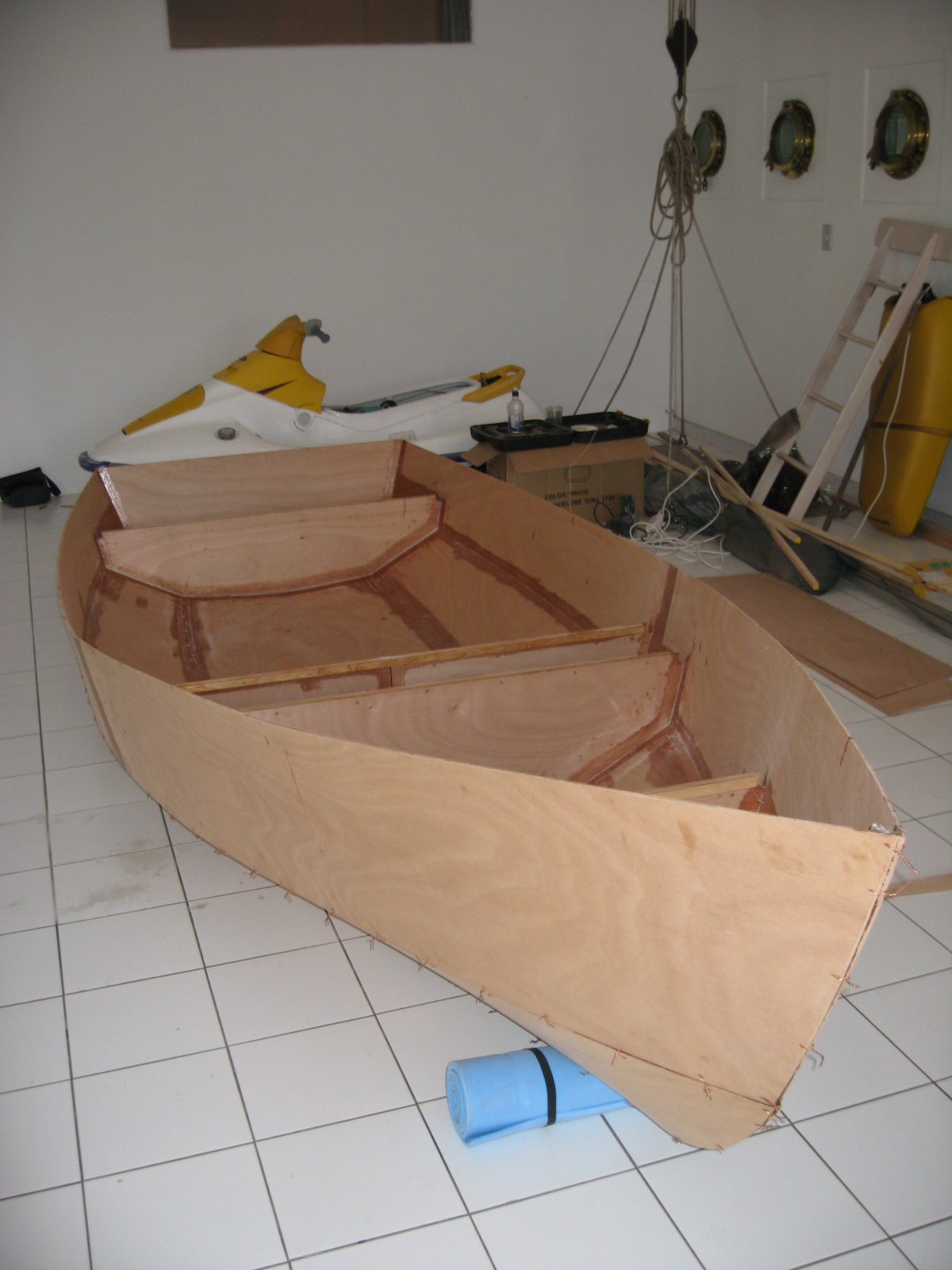
Saturday, 14 August 2010
Toylander lower steering column mount details


Left click picture to enlarge it and see more details.
Friday, 13 August 2010
Toylander birthday toy
Well it may as well be Lukes for now but he has two cousins,so they will have to share this toy,unless their respective dads want to build each their own Toylander.This past week was a learning curve,as the wheels and steering were installed,a list of what screws,nuts and bolts required to assemble with was made,this will form a part of the Toylanders full kit,those plus hinges and things like the special tail gate latches we have.


The kit has gone in phases,we are now at a stage when the CNC work has been updated,some minor additions to make,small items like two half moon shaped stops to fit behind the folding seat,we will soon be ready to supply customers with the Toylander body kit,plus the axles,wheels and steering,foot and hand brake system,next development will be the electrics and drive motor parts,one extra to be offered will be a front bonnet spare wheel and mounting base.


For sure these pictures proove that a Toylander is right for children from a very early age,grown ups and pets by the looks of it too!
Thursday, 12 August 2010
Toylander loading for Lukes 1st birthday


P.L.U.T.O (pipe lines under the ocean)
More technical stuff today,it was Toylander steering geometry yesterday,today its an amazing story sent to me by a good friend Notty in England,its news to me about miles of lead pipes under the English Channel to serve as fuel supply to the WW2 forces.Check this link out for more detailed info on this amazing story.
http://www.combinedops.com/pluto.htm
P.L.U.T.O
Pipeline under the Ocean
To many of those consulted it seemed a preposterous idea... an undersea pipe-line laid across the bed of the English Channel to fuel the advance of the Allied armies from the Normandy beaches. Nothing like it had ever been attempted before. It would have to be done in the utmost secrecy - concealed from the eyes of friend and foe alike. The experts shook their heads. It was surely impossible.
Fortunately, not everyone shared that view. First suggested by Lord Louis Mountbatten, Britain's Chief of Combined Operations, the project called for the highest levels of engineering prowess and ingenuity -and an abundance of endeavour, enthusiasm and energy.It needed a flair for the unorthodox and a determination to succeed against the odds.
That there were people who were both able and willing to fulfil such a formidable mixture of requirements, and turn Mountbatten's 'impossible' plan into astonishing reality, speaks volumes for the indomitable British wartime spirit The plan evolved into Operation PLUTO, the Pipe-Line Under The Ocean. It ran - initially, at least - for 70 miles along the Channel seabed from the Isle of Wight to Cherbourg, and then on the shorter route between Dungeness, in Kent, and Boulogne. The Germans failed to detect it And it worked!
PLUTO was one of the greatest of Britain's wartime secrets and - in the words of Eisenhower - it was "second in daring only to the artificial (Mulberry) harbours."
Published in paperback by Shanklin Chine and incorporating 50 illustrations.
Price £7.99+ £1.51 P&P.
 This sounds like one of those must read books to have on your book shelves.
http://www.combinedops.com/pluto.htm
P.L.U.T.O
Pipeline under the Ocean
To many of those consulted it seemed a preposterous idea... an undersea pipe-line laid across the bed of the English Channel to fuel the advance of the Allied armies from the Normandy beaches. Nothing like it had ever been attempted before. It would have to be done in the utmost secrecy - concealed from the eyes of friend and foe alike. The experts shook their heads. It was surely impossible.
Fortunately, not everyone shared that view. First suggested by Lord Louis Mountbatten, Britain's Chief of Combined Operations, the project called for the highest levels of engineering prowess and ingenuity -and an abundance of endeavour, enthusiasm and energy.It needed a flair for the unorthodox and a determination to succeed against the odds.
That there were people who were both able and willing to fulfil such a formidable mixture of requirements, and turn Mountbatten's 'impossible' plan into astonishing reality, speaks volumes for the indomitable British wartime spirit The plan evolved into Operation PLUTO, the Pipe-Line Under The Ocean. It ran - initially, at least - for 70 miles along the Channel seabed from the Isle of Wight to Cherbourg, and then on the shorter route between Dungeness, in Kent, and Boulogne. The Germans failed to detect it And it worked!
PLUTO was one of the greatest of Britain's wartime secrets and - in the words of Eisenhower - it was "second in daring only to the artificial (Mulberry) harbours."
Published in paperback by Shanklin Chine and incorporating 50 illustrations.
Price £7.99+ £1.51 P&P.

Wednesday, 11 August 2010
Steering set ups on our works Toylander kit car
 The natty black steering wheel is not part of our kit as yet,its one I happened to have off a go kart,I expect they can be sourced,we will supply pre cut plywood steering wheels as found in a drawing at the back of the builders guide.
After fitting the front and rear wheel axles with tempoary chip board screws,I found it best to have the Toylander on its side for drilling of the required 6mm hole to allow the correct bolts to be fitted.


The builders manual tells you how to centralise the front wheels,its not a bad system,hard to left and mark the steering link,then hard to right,mark that,then remove the lower bar you have marked,find the center between each mark and drill a 6mm hole,its as simple as that!


Subscribe to:
Posts (Atom)


