Friday, 30 October 2015
Our wood / epoxy Optimist sailing dinghy
This started with a five boat kit order, then became an eight kit order as we progressed with the building of the first one.
Price wise we were way out in front against the very costly imported GRP boats and its said ours when fully rigged and with a North Sail as well cost half the amount other boats were costing ?
Roy
Price wise we were way out in front against the very costly imported GRP boats and its said ours when fully rigged and with a North Sail as well cost half the amount other boats were costing ?
Roy
Out and about with a Hillman Imp Californian
The car is still a way off being finished but it is safe to drive on public roads and carries the correct licence disc.
This is a local spot that is busy with locals and tourists daily.
The cars engine is still the original one, an export model and still on the same pistons and crank bearings the Rootes Scotland fitted the engine with, I did fit new piston rings some years back.
Hout Bay !
Roy
Click on the image to enlarge it.
The car was built in 1967.
This is a local spot that is busy with locals and tourists daily.
The cars engine is still the original one, an export model and still on the same pistons and crank bearings the Rootes Scotland fitted the engine with, I did fit new piston rings some years back.
Hout Bay !
Roy
Thursday, 29 October 2015
A transocean peddle boat, the one that got away
This one we were asked to supply the 9mm okoume marine plys and also cut the panels with a CNC machine to the design by Dudley Dix.
For some reason it never happened and the boat was built from plans instead?
I am not that sure this will find many buyers for the intended purpose but I think the design may be used to turn it into some other use, shallow water sailing comes to mind?
We are open to suggestions.
Roy
Davids pedal boat, plywood boat plans, plywood pedal boat, stitch-&-glue plywood, trans-ocean pedal boat, transocean pedal boat
For some reason it never happened and the boat was built from plans instead?
I am not that sure this will find many buyers for the intended purpose but I think the design may be used to turn it into some other use, shallow water sailing comes to mind?
We are open to suggestions.
Roy
Davids pedal boat, plywood boat plans, plywood pedal boat, stitch-&-glue plywood, trans-ocean pedal boat, transocean pedal boat
Wednesday, 28 October 2015
Signal flare disposal in South Africa ?
This comes around every few years?
What do we do with our date expired boat flares?
I took a plastic shopping bag full to the Hout Bay fire department, they advised to take them to SAPs, (south african police service) which I did and they took them off my hands.
I wonder what they now do with them?
Even my older flares still look as they were when purchased new.
Roy
What do we do with our date expired boat flares?
I took a plastic shopping bag full to the Hout Bay fire department, they advised to take them to SAPs, (south african police service) which I did and they took them off my hands.
I wonder what they now do with them?
Even my older flares still look as they were when purchased new.
Roy
Tuesday, 27 October 2015
Wooden what? seen here in Hout Bay, South Africa
This came in a few days back, I thought it was another
converted and German Mine sweeper, maybe it is?
We had some conversions going on here a few years back,
German boats sold to Japan I think, then bought and converted in the Simonstown
naval dockyard for service work in Nigeria.
http://ckdboats.blogspot.co.za/2011/02/storm-petrel-by-another-name.html
Any ideas?
Here is a well qualified comment from a master marine engineer,
Roy,
I
can only assume as you did that she is an ex-minesweeper if constructed of
timber. The low open deck aft is another signature feature of a
minesweeper.
It’s
possible that she is one of a large number of ex-naval and other craft that have
been pressed into commercial service for security / anti-pirate patrols and
escort duties in east and west Africa – Nigeria as you mentioned. She looks to
be in good condition.
The
fact that she’s in Hout Bay means that she must have already been cleared-in at
Table Bay or some other SA port.
Any
identification markings, flags, etc, on her? Is she shut-down and on shore-power
or is she running her generators?
Roy
It was only by the next day did I find out the ship was part of a filming production ( i know the name ) and was by then flying a French national flag.
Another exciting event in the Hout Bay harbour was over.
Roy
Roy
It was only by the next day did I find out the ship was part of a filming production ( i know the name ) and was by then flying a French national flag.
The ships markings had been DTC 8799, they had been removed for the filming , a house flag was also flying.
The ship has a really nice bronze anchor.
By 5pm a Table Bay service tug had taken the ship out into the bay and back to where ever the ship is normally berthed?
Out in the bay and on its way.
Roy
Where is Devils Isle?
This was a question I was asked by an American cruising sailor once.
I told him that its easy to find and that you cannot miss it.
He replied I can if I dont know where it is?
I told him that its easy to find and that you cannot miss it.
He replied I can if I dont know where it is?
I will post a map later.
The picture came to me from my good friend Notty who went there on a Fortuna 37 with his wife and son,
Dated 1994 click on the images to enlarge them.
Devils Isle is almost not in this picture as its the spec of land to the left, part of the planes wing gear can be seen also.
The large island is Royale with St Joseph at the back, we anchored there for around a week.
Roy
Sunday, 25 October 2015
Story writing or blogging?
This week I got to meet John and was then talking to a regular blog reader who I had no idea existed .
We do have a common connection as it turns out as I knew his late dad very well and I am pleased to say I know his brother very well too.
The writing really started about ten years back and before the blog writing began, then as the blog expanded I slowed down on the actual story writing and then expanded the blog on a near daily basis.
http://forum.theimpclub.co.uk/viewtopic.php?f=12&t=27433
The link needs to be copied and pasted into Google, you will then have to sign in as a non member to access the forum pages.
This blog slowed some around 2013 when I was asked to rebuild a 1971 Hillman Imp, that took me to an Imp Club forum, then I started the thread on the Imp and of course had less time for my own blog.
The Imps all have drum brakes all round, in the case of the 1971 Hillman Imp the owner chose to have me fit the disc brake conversion kit.
While the rebuild was happening and it took over a year, I was able to buy back my own 1967 Hillman Imp Californian coupe, a rare car these days. This saw me working on both cars as time allowed, I then opened an Imp Club Forum page on the red Imp Californian, that is now at some sixty eight (68) pages and covers the cars rebuild in some detail.
The blue Imp is now finished and with its owner, the red Imp coupe can be my daily driver should I want to use it? It is fully roadworthy and is licenced and insured.
The cars interior has been re done, the carpets and head liner have still to be fitted.
There is also a set of front disc brakes ready to fit, the suspension will also be lowered 1" (25mm) by fitting the Monte Carlo competition road springs.
So with all this going on the writing stopped for places like Duckworths Magazine but I guess folk still read the stories from time to time?
http://hbycclub.blogspot.co.za/2009/10/roys-articles-in-duckworks-magazine.html
Same again, if the link does not open for you please copy and paste it into Google.
There are ten stories there, one is in two parts, so lots to read if you have the time?
Roy
We do have a common connection as it turns out as I knew his late dad very well and I am pleased to say I know his brother very well too.
The writing really started about ten years back and before the blog writing began, then as the blog expanded I slowed down on the actual story writing and then expanded the blog on a near daily basis.
http://forum.theimpclub.co.uk/viewtopic.php?f=12&t=27433
The link needs to be copied and pasted into Google, you will then have to sign in as a non member to access the forum pages.
This blog slowed some around 2013 when I was asked to rebuild a 1971 Hillman Imp, that took me to an Imp Club forum, then I started the thread on the Imp and of course had less time for my own blog.
The underside of the car was stripped and refinished first.
The pictures should enlarge when you click on them.
The cars original block was bored out from the standard 875cc and then fitted with 998cc liners and pistons.
The Imps all have drum brakes all round, in the case of the 1971 Hillman Imp the owner chose to have me fit the disc brake conversion kit.
While the rebuild was happening and it took over a year, I was able to buy back my own 1967 Hillman Imp Californian coupe, a rare car these days. This saw me working on both cars as time allowed, I then opened an Imp Club Forum page on the red Imp Californian, that is now at some sixty eight (68) pages and covers the cars rebuild in some detail.
The blue Imp is now finished and with its owner, the red Imp coupe can be my daily driver should I want to use it? It is fully roadworthy and is licenced and insured.
The cars interior has been re done, the carpets and head liner have still to be fitted.
There is also a set of front disc brakes ready to fit, the suspension will also be lowered 1" (25mm) by fitting the Monte Carlo competition road springs.
So with all this going on the writing stopped for places like Duckworths Magazine but I guess folk still read the stories from time to time?
http://hbycclub.blogspot.co.za/2009/10/roys-articles-in-duckworks-magazine.html
Same again, if the link does not open for you please copy and paste it into Google.
There are ten stories there, one is in two parts, so lots to read if you have the time?
Roy
Friday, 23 October 2015
Optimist kit now packing for Switzerland
Some may wonder why we have to include a packing charge when the kit you have bought is shipped by road or sea?
in this case we used a sheet of pine 9mm ply top and bottom, the five steel bands then can be made very tight to secure the package, which probably weighs in at 80 kgs.
These pictures demonstrate the steel banding, the pack in this case is okoume marine plywood and not the Optimist kit, the images should explain the process we use?
The actual CNC cut kit will be loaded into the purpose made packing crate on monday.
Click on the images to enlarge them.
The crate is being made today.
It has a 9mm pine ply sheet top and bottom, with 6mm plys on each side and the ends, glued and nailed it will be quite secure when the 16mm steel band strapping is applied.
Pictures of the loading will be added later.
Roy
Machining the 998cc Hillman Imp block
This was done for me by Bremco back in 1971, they used a Mk1 block with liners and pistons I sourced from the Rootes Competition Department in Coventry, England.
In more recent times I took over a Mk2 block that a local auto engineer had converted, it looked great, its a pity it looked better than it actually was.
The new liners all had to come out, they had been installed at different hight's, so the head gasket would never seal.
In more recent times I took over a Mk2 block that a local auto engineer had converted, it looked great, its a pity it looked better than it actually was.
The new liners all had to come out, they had been installed at different hight's, so the head gasket would never seal.
Its a bit of a long story but in the end I sorted out the problem myself, Then used a general engineer who had more interest in doing the job correctly.
He in turn knew a marine engineer with a surfacer with a magnetic deck, who faced off the top of the block and liners to perfection.
This work can now be done here in Cape Town, you need to supply your own Imp engine block though.
The engine in the pictures is now back in its original 1971 Hillman Imp, fitted with the cylinder head and a new Solex carburetor, it started first time.
Roy
Thursday, 22 October 2015
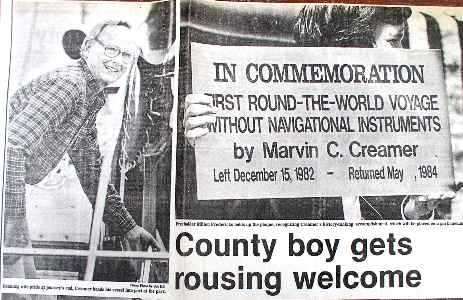
Marvin Creamer and Globe Star
I mentioned meeting the man.
This was probably early in 1983?
We were both having an early morning shave, standing at the sinks of the men's locker room at the Royal Cape Yacht Club in Cape Town.
http://www.globestar.org/photos.htm
The GLOBE STAR completed a successful circumnavigation of the globe, skippered by Professor Marvin Creamer of New Jersey. Creamer navigated without the use of compass, sextant or electronic instruments! He eschewed even a wristwatch, but took an hourglass for changes of watch! Actually, a sextant, clock, compass and radio were sealed in a locker below deck in event of an emergency, but these remained sealed for the entire journey, which was attested to and notarized by proper inspections.
This was probably early in 1983?
We were both having an early morning shave, standing at the sinks of the men's locker room at the Royal Cape Yacht Club in Cape Town.
http://www.globestar.org/photos.htm
The GLOBE STAR completed a successful circumnavigation of the globe, skippered by Professor Marvin Creamer of New Jersey. Creamer navigated without the use of compass, sextant or electronic instruments! He eschewed even a wristwatch, but took an hourglass for changes of watch! Actually, a sextant, clock, compass and radio were sealed in a locker below deck in event of an emergency, but these remained sealed for the entire journey, which was attested to and notarized by proper inspections.
The boat was equipped with a transmitter which sent signals at regular intervals so that the Coast Guard knew of the boat's whereabouts. When it malfunctioned, the media reported the crew missing. After the Globe Star reached port, Creamer called his wife, who had more confidence in her husband's abilities than in electronics!
http://www.globestar.org/feat.htm
The route.
Cape Towns RCYC berthing back then.
The man himself.
Well done Marvin!
Roy
Hokule sailing our way to Hout Bay
They may not find space in the Hout Bay harbour?
They have Just cleared Richards Bay and may want a spot
to keep their ship when in our waters?
Sailing around the world without a GPS or Sextant sounds interesting, I once met with Marvin Creamer at the RCYC, he was on a voyage with one crew around the world and using only the stars, sun, moon and planets, he made it too!
Roy
Port Officer OCC
My thanks for the use of this super quality picture, click on it to view full screen.
I have has mails from Heidi, she is part of the group that are sailing down the South African coast.
I am not sure if she is sailing on the 61 ft long sailing cat or the steel support yacht that is sailing with the cat.
Aloha (warm greetings from
Hawaiʻi),
We received your contact
information from some friends who are members of the Ocean Cruising Club.
The
Polynesian Voyaging Society (PVS) is humbled to have our traditional,
double-hulled voyaging canoe Hōkūleʻa continue on her first Worldwide Voyage
from Honolulu, Hawaiʻi, and visit some special ports in South Africa, possibly
including Hout Bay. (photo of Hōkūleʻa attached) We just cleared Customs,
Health and Immigration in Richards Bay on Oct. 19, and may seek to visit your
port if we need to avoid weather en route to Cape Town. We would be grateful
for help in, and advice about, a place that we do not yet know.
Hōkūleʻa (a double-hulled, traditional voyaging canoe) has no
auxiliary power and only sails within the parameters of safety and weather, with
Gershon II (a monohull motor sailor) sailing nearby only for safety and any
necessary towing to get Hōkūleʻa out of weather situations. (See specification
sheets, attached) Because Hōkūleʻa is completely reliant upon weather
conditions for sailing, we cannot commit to dates of arrival and
sail.
We are,
however, planning an arrival ceremony in Cape Town on either November 14 or 21,
2015. We will be conducting educational outreach and exchange there for a week,
before going into dry dock to prepare for our Atlantic crossing at the end of
December to visit more like-minded, ocean-based communities before returning to
the Pacific and home to Hawaiʻi in 2017.
More on this when I find out.
http://www.hokulea.com/
Roy
Wednesday, 21 October 2015
The Optimist Meranti wood optional offer
Some while back we stopped offering the machined wood to our kits.
We have now found a timber company who are able to cut and machine meranti so have been able to supply the client of the Optimist kit we are about to pack.
The bundle of meranti wood is well selected and has machined up really nicely.
We have now found a timber company who are able to cut and machine meranti so have been able to supply the client of the Optimist kit we are about to pack.
The bundle of meranti wood is well selected and has machined up really nicely.
Packing for its shipping to Switzerland starts tomorrow!
Roy
Sunday, 18 October 2015
An Optimist kit set to Switzerland
We have shipped the Optimist kit set to Switzerland before, this one should pack next week and will then be on its way.
Click on the pictures to enlarge them.
The wood / epoxy Optimist design requires a builders jig, we developed our own to suit our kit.
The rudder and dagger board, plus the sides of the dagger board case and some foot strap mount blocks are all included.
The wood / epoxy Optimist design requires a builders jig, we developed our own to suit our kit.
The rudder and dagger board, plus the sides of the dagger board case and some foot strap mount blocks are all included.
The bottom of the wood / epoxy Optimist is 12mm thick.
All plys are okoume species veneers to the BS 1088 standard, its the lightest ply we can use within the Optimist class rules.
There is very little space wasted on each ply panel, that makes our kit as cost effective as it can be.
Not shown are the two temporary hull spacers, the meranti wood and a carton with epoxy, glass tape, micro balloons and fumed silicas to make fillers and pastes to form corner fillets.
We also supply a detailed builders instruction book, which includes pictures to guide you through each step of the building process.
Recently a sailing school in the USA asked for details on the builders jig and the assembly, I sent the link below.
With the very low exchange rate to the Rand currency, buying from South Africa has never made so much sense?
We have sent these kits to places like the USA, Greece, Switzerland and can normally ship world wide at a reasonable cost.
Roy
Thursday, 15 October 2015
The Loggerheads Inn, North Wales
Another picture of a Welsh public house was taken in 1961 and by my dad Robert Henry McBride.
Our Morris Oxford is loaded with camping gear, the registration was OKC 475, with a 1400cc side valve engine, it was not the most powerful of cars for camping.
Coordinates:
53°09′16″N 3°12′51″W / 53.15433°N 3.21423°W / 53.15433; -3.21423
Loggerheads is a village in Denbighshire, Wales on the River Alyn, a tributary of the River Dee.
It has a country park which follows the course of the River Alyn through karstic limestone countryside including the sites of old lead mines and mills. there is a working flour mill on site.
A leat or leete, built around 1824 follows the side of the valley nearby and was used to carry water to the lead mines of Mold Mines, on land owned by the Grosvenor family. It is now the popular Leete Walk. The name Loggerheads may come from the dispute over estate boundaries between the lordships of Mold and Llanferres. The final boundary is marked by Carreg Carn March Arthur which is said to bear the imprint of Arthur's horse's hoof after it jumped from the nearby mountain, Moel Famau. The local pub has a sign showing two men grimacing at each other with the words We Three Loggerheads,[1] taken from a painting by Richard Wilson. The third loggerhead was the viewer.
Fifty years on and the place is little changed.
Roy
Our Morris Oxford is loaded with camping gear, the registration was OKC 475, with a 1400cc side valve engine, it was not the most powerful of cars for camping.
From Wikipedia, the free encyclopedia, ( my thanks to Wikipedia for the information.)
Jump to: navigation, search
| Loggerheads | |
We Three Loggerheads | |
|
| |
| Population | (2001) |
|---|---|
| Principal area | Denbighshire |
| Ceremonial county | Clwyd |
| Country | Wales |
| Sovereign state | United Kingdom |
| Police | North Wales |
| Fire | North Wales |
| Ambulance | Welsh |
| EU Parliament | Wales |
| UK Parliament | Vale of Clwyd |
| Welsh Assembly | Vale of Clwyd |
| |
Loggerheads is a village in Denbighshire, Wales on the River Alyn, a tributary of the River Dee.
It has a country park which follows the course of the River Alyn through karstic limestone countryside including the sites of old lead mines and mills. there is a working flour mill on site.
A leat or leete, built around 1824 follows the side of the valley nearby and was used to carry water to the lead mines of Mold Mines, on land owned by the Grosvenor family. It is now the popular Leete Walk. The name Loggerheads may come from the dispute over estate boundaries between the lordships of Mold and Llanferres. The final boundary is marked by Carreg Carn March Arthur which is said to bear the imprint of Arthur's horse's hoof after it jumped from the nearby mountain, Moel Famau. The local pub has a sign showing two men grimacing at each other with the words We Three Loggerheads,[1] taken from a painting by Richard Wilson. The third loggerhead was the viewer.
Fifty years on and the place is little changed.
Roy
Subscribe to:
Posts (Atom)